
Chief Secretary Atal Dulloo announced that the Census 2027 will be a fully digital and paperless exercise, utilising mobile technology, AI, and cloud computing for accuracy and efficiency, marking a shift towards data-driven governance.
Odisha and Uttar Pradesh are among the first to roll out the digital exercise.
The 2027 Census may cost a bit more due to the proposed use of apps and smartphones by the 3.4 million enumerators who will collect comprehensive data much more efficiently than in earlier times.
'There will be not less than 31 lakh people working in the census process.'
India has launched digital tools for its upcoming fully digital Census 2027, including mobile apps and a self-enumeration portal, aiming for efficient and accurate data collection.

The census will be carried out with a reference date of October 1, 2026 in snow-bound areas like Ladakh and March 1, 2027 in the rest of the country, the notification said.
Population Foundation of India welcomes the digitisation of the Census but emphasises the need for inclusivity, data security, and addressing the under-reporting of women's contributions.

2027's housing census trims questions but adds digital-age indicators like Internet and smartphones.

This will be India's 16th Census and the eighth since Independence. For the first time, citizens will also have the option of self-enumeration.

The Union Cabinet on Friday approved Rs 11,718 crore for conducting the Census of India, 2027, which would include the caste enumeration for the first time.

'Once the numbers come out, they fear that the OBCs would start to demand, and articulate what they are lacking, why they are lacking and what should be done to go forward.'

The Indian government has released the list of questions to be asked during the first phase of the Census 2027, focusing on houselisting and housing enumeration. The survey will cover various aspects of housing conditions, household characteristics, and access to basic amenities.

The NDA government has gradually nuanced its position on the issue of demographic challenge.

The Registrar General and Census Commissioner of India, Mritunjay Kumar Narayan, has reassured the public that individual data collected during the upcoming census will remain confidential and cannot be used for any purpose other than statistical aggregation.
The next Census' findings will help identify the extent of India's ageing population and vulnerability levels.
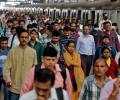
'What is going on is the under counting of the migration population in urban areas.' 'It has been going on in the last few censuses.'

Census exercise with caste enumeration will be carried out with the reference date of October 1, 2026, in snow-bound areas like Ladakh and of March 1, 2027, in the rest of the country, the Home Ministry announced on Wednesday.

A special dedicated web portal will be launched for self-enumeration during the upcoming Census, which will be available for both phases of the national enumeration exercise, officials said Monday.

Congress leader Shashi Tharoor criticised the proposal to increase the Lok Sabha's strength to 850, while BJP leaders defended delimitation as a democratic necessity at the Stanford India Conference 2026.

A bill to implement 33 per cent reservation for women in Lok Sabha and state assemblies by increasing the lower house's strength to 850 is slated for introduction in Parliament. The bill seeks to amend Article 81 of the Constitution and utilise 2011 Census data for redrawing constituencies.

'The reason why they rushed through the bill was they wanted to avoid using the 2026 Census because the 2026 Census by their own decision will be a caste census.' 'The BJP knows that a significant share of the OBCs who will get captured in the census, for the first time after the 1931 Census, are against the BJP. Only a segment of the OBCs are in their favour.' 'So they wanted to avoid the OBC reservation among women, which is a demand of a lot of Opposition parties.'

The Women's Reservation Act 2023, mandating 33 per cent quota for women in legislatures, has been enacted, but its immediate implementation is unclear due to ongoing parliamentary debates and delimitation requirements.

Prime Minister Narendra Modi announced that Parliament is on the verge of creating 'new history' by amending the Women's Reservation Act this week, ensuring its implementation by 2029. He highlighted the unanimous passage of the law in 2023 and the collective demand for its early enforcement.

'The Supreme Court stated that once the delimitation plan is approved by Parliament and receives assent of the President, it cannot be undone. Nor can it be modified.'

'You cannot run Parliament with 800 MPs as nobody will get time (to speak in Parliament). And Parliament sits for barely 60 days in a year.' 'Look at the House of Commons of the United Kingdom. They have 650 MPs and they sit for 150 days on an average in a year.'

The Indian Parliament is expected to extend its budget session to introduce a bill increasing Lok Sabha seats to 816, reserving 273 for women, and amending the women's reservation law.

'All this talk about women's reservation and Nari Shakti is a mirage.' 'It is a classic Trojan horse to bring about an alteration in the structure of political competition -- to the enduring advantage of the BJP.'

'It is for the first time in Independent India that collection of information on caste is being done.'

'All governments are scared of a negative image.' 'Somehow, this government has a tendency to create a narrative that things are improving.' 'When the real data gives a different picture, they are upset.'

'The general elections in May 2024 may not have any impact on the Census.'
Although the Disaster Management Act for Covid containment measures, considered a hindrance in conducting the census, was withdrawn in March this year the Centre has not taken any further action on conducting the much-delayed population enumeration.
'Modi's charisma may have weakened as last year's Lok Sabha poll results showed but in the eyes of the Sangh Parivar, it has not waned.' 'Minus a strong BJP government at the Centre for another decade and more, there is apprehension that an anti-Hindutva government could reverse many of the ideological gains that the Modi dispensation has achieved through its three terms,' points out N Sathiya Moorthy.

The decision to permit the third child came after this month's once-in-a-decade census showed that China's population grew at the slowest pace to 1.412 billion amid official projections that the decline may begin as early as next year.

Despite the relaxation of the one-child policy in 2016, the number of live births per 1,000 people fell to a record low of 10.48 in 2019, down from 10.94 in 2018.
